

Ask most Australian schools how staff know a lockdown has started and the answer is still some version of the bell. Continuous short rings. Three long blasts. A pattern written into the emergency plan and practised once or twice a year. It works on drill day, when everyone knows it is coming. The harder question is whether a school lockdown alarm built on the bell works on a real day, when nobody is expecting it and the first few seconds decide everything.
This article looks at where bell codes fall short, what a distinct lockdown signal should do, and what to check before you choose a system.
Why the school bell was never designed for emergencies
The bell exists to move a school through its day. It rings for the start of class, recess, lunch and home time, many times a day, every day. That is exactly the problem. Students and staff have spent years learning to treat it as background noise.
When a lockdown is signalled with a variation of that same sound, people have to stop, listen, count and decode before they act. In a calm drill that takes a few seconds. Under stress, with a class half outside, a radio playing or a lawnmower running on the oval, it can take much longer, or the pattern gets misread entirely.
There are three common failure points with bell-based lockdown signals:
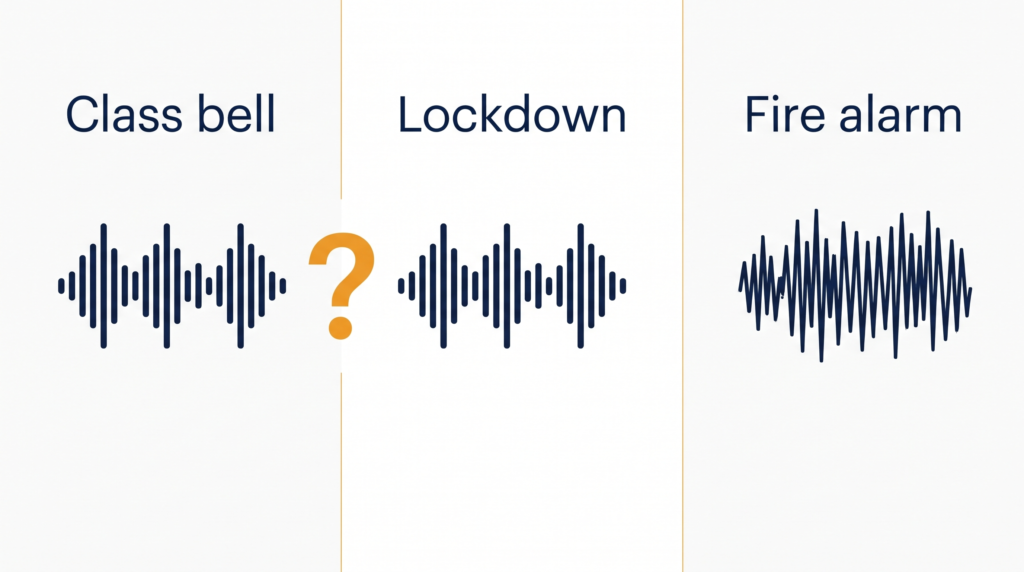
- Confusion with routine bells. A lockdown pattern that sounds like a class change gets ignored, especially by casual relief teachers and visitors who have never heard the code.
- Confusion with the fire alarm. Lockdown means stay in and secure. Evacuation means get out. If the two signals are easy to mix up, people can move towards a threat instead of away from it.
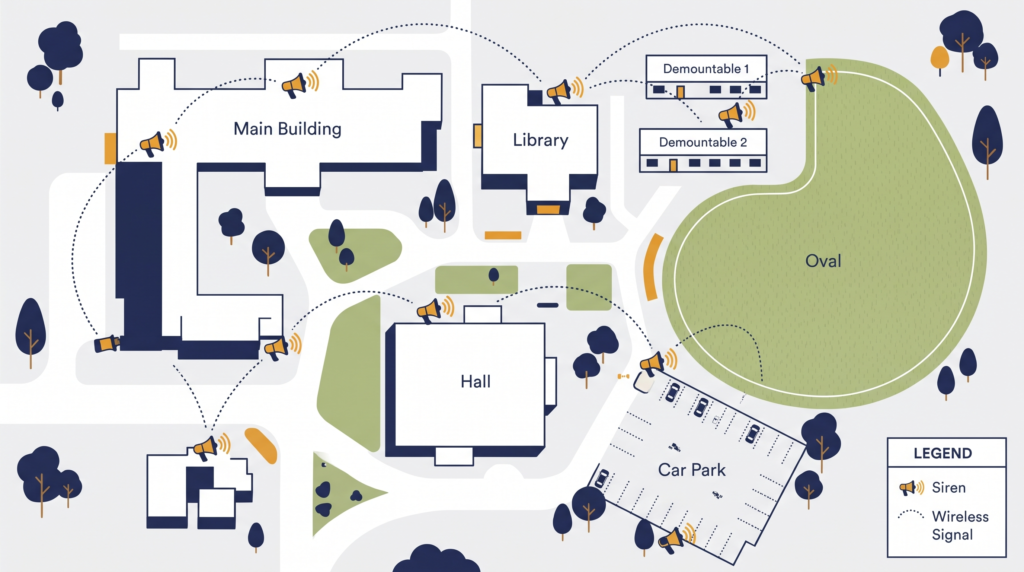
- Coverage gaps. Bells are usually wired to buildings. Ovals, car parks, demountables, canteens, sports courts and the far end of a large campus are often where the bell is weakest, and where students spend a lot of their day.
What a distinct School Lockdown Alarm signal actually needs to do
A good school lockdown alarm is not just louder. It is unmistakable. Whoever hears it should know what it means and what to do without having to think about it. In practice that means five things.
1. Sound different from everything else on site
Lockdown, evacuation and all clear should each have their own tone. None of them should resemble the class bell or the fire alarm. Many schools now add a short spoken message (“Lockdown. Lockdown.”) so there is no room for interpretation, including for new staff and visitors.
2. Reach every part of the campus
The signal has to be heard where people actually are: inside classrooms, in the library and hall, and outside on the playground, oval and car park. Indoor and outdoor coverage are different jobs. Outdoor areas need high-volume sirens. Indoor spaces often need lower-volume speakers so the message is clear without causing panic.
3. Be seen as well as heard
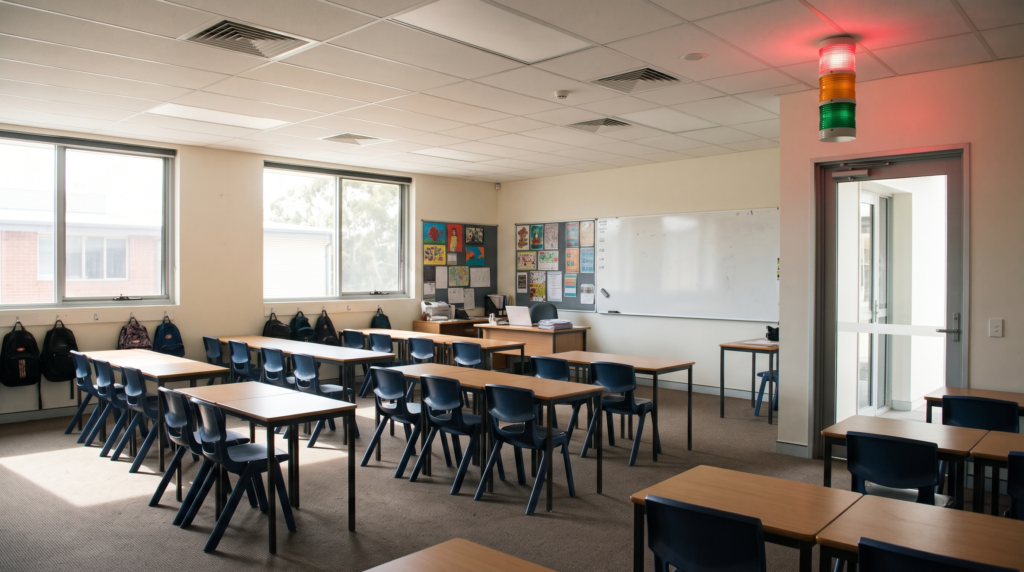
Students with hearing impairment, noisy areas such as workshops and gyms, and students wearing headphones can all miss an audible alert. Colour-coded strobe beacons give a second channel. One colour for lockdown, another for evacuation, another for all clear.
4. Be triggered fast, from more than one place
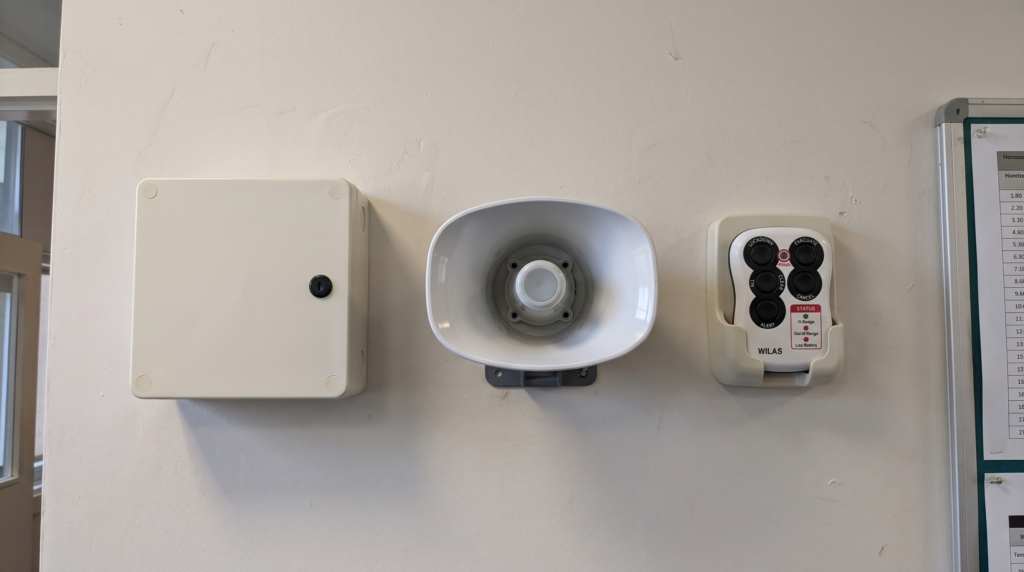
If only the front office can start a lockdown, the alert depends on someone getting to that office. Wall-mounted activation points around the site, plus handheld remotes for key staff on yard duty, mean the first person to see a threat can raise the alarm on the spot.
5. Keep working when something else fails
Power outages, a cut cable or a single failed control panel should not silence the whole system. Battery backup, and a design with no single point of failure, matter more than most specification sheets admit.
Wired upgrades vs wireless lockdown alarm systems
Many schools assume a proper lockdown system means trenching, cabling and weeks of disruption. That is true of some hardwired systems, particularly across older buildings, heritage sites and campuses with lots of demountable classrooms.
A wireless emergency alert system works differently. Each control unit is self-contained and powered by battery, charged from mains or solar. The units talk to each other by radio, so a siren on the far side of the oval does not need a cable run back to the office. The practical benefits for schools are:
- Installation can often be done with far less disruption to teaching.
- New buildings and portables can be added to the network as the school grows.
- With no central master panel, there is no single box whose failure takes down every alert.
A quick checklist for reviewing your lockdown signal
Use these questions at your next emergency management plan review:
- ☐ Could a casual relief teacher tell your lockdown signal apart from the class bell on their first day?
- ☐ Does the lockdown signal sound clearly different from your evacuation and fire signals?
- ☐ Can it be heard on the oval, in the car park and in every demountable?
- ☐ Is there a visual alert for students with hearing impairment and for noisy spaces?
- ☐ Can staff on yard duty start a lockdown without running to the office?
- ☐ Does the system work during a power outage?
- ☐ Is there a distinct all clear, so people know when it is safe?
If any answer is “no” or “not sure”, the bell is probably doing a job it was never designed for.
How Hazavoid approaches school lockdown and evacuation alerts
Hazavoid’s Wireless Emergency Alert System (WiLAS) was developed and is manufactured in Australia by Inventis Technology, a Sydney-based manufacturer operating since 1984. It delivers loud, easily distinguished Lockdown, Evacuation and All Clear alerts, with tones and spoken voice-overs that can be customised to match a school’s own procedures.
The system pairs outdoor sirens with indoor speakers and optional colour-coded strobe beacons for indoor and outdoor areas. Alerts can be triggered from handheld wireless remotes or wall-mounted activation points placed around the site. Each control module runs on battery with mains or solar charging, and the network has no central master control panel, so there is no single point of failure. It can also integrate with existing fire control panels.
Hazavoid is ACMA and FCC certified and holds Australian and US patents.
Next step: test your signal against a real day
A lockdown signal should be judged on the worst day, not on drill day. If your school is reviewing its emergency management plan, adding buildings, or simply unsure whether everyone on site would recognise the bell code, it is worth getting a second opinion.
Talk to the Hazavoid team about a lockdown and evacuation alert setup sized to your campus. Email support@hazavoid.com or call 1300 003 339.
Frequently Asked Questions
What is a school lockdown alarm?
A school lockdown alarm is an alert that tells staff and students to move indoors, secure rooms and stay out of sight until an all clear is given. It should sound and look different from the class bell and the fire alarm.
Can we just use the school bell for lockdown?
Many schools do, but bell codes are easy to confuse with routine bells, can be mistaken for an evacuation signal, and often cannot be heard on ovals or in car parks. A dedicated tone with a spoken message removes the guesswork.
What is the difference between a lockdown and an evacuation alert?
A lockdown alert means stay inside and secure your space. An evacuation alert means leave the building and go to the assembly area. Because the actions are opposite, the two signals must be impossible to mix up.
Do lockdown alarms need visual alerts as well?
Visual alerts such as colour-coded strobe beacons help students and staff with hearing impairment, and anyone in a noisy area like a workshop, gym or canteen.
Does a wireless lockdown system work in a power outage?
A well-designed wireless system runs on battery, charged from mains or solar, so alerts still work if the mains power fails.
Can a lockdown alarm connect to our existing fire panel?
Some systems can. Hazavoid’s system can integrate with existing fire control panels, which helps keep fire and lockdown responses coordinated.