

On September 3, 2026, schools across the Philippines joined DepEd’s National Simultaneous School Safety Drill. Public and private schools took part. It was not a staged emergency. Schools practiced safety procedures without actors, props, or frightening scenarios.
The drill started with one clear step. Schools sounded a distinct alarm, separate from the signals used for fire and earthquake drills. This small detail carries a big responsibility. DepEd asks every school to have its own non-fire, non-earthquake duress signal. However, many schools still use the same bell or PA system for every emergency. This can cause confusion when quick action matters most.
This article explains what the DepEd school safety drill requires. It also covers why a distinct lockdown alarm matters and how schools can choose the right system.
What the DepEd School Safety Drill Requires
DepEd guides the drill through its School Contingency Plan for active threat situations. The department launched pilot drills at Manila Science High School in July 2026. The plan adds four procedures to each school’s existing Disaster Risk Reduction and Management (DRRM) plan: lockout, lockdown, evacuation, and reunification.
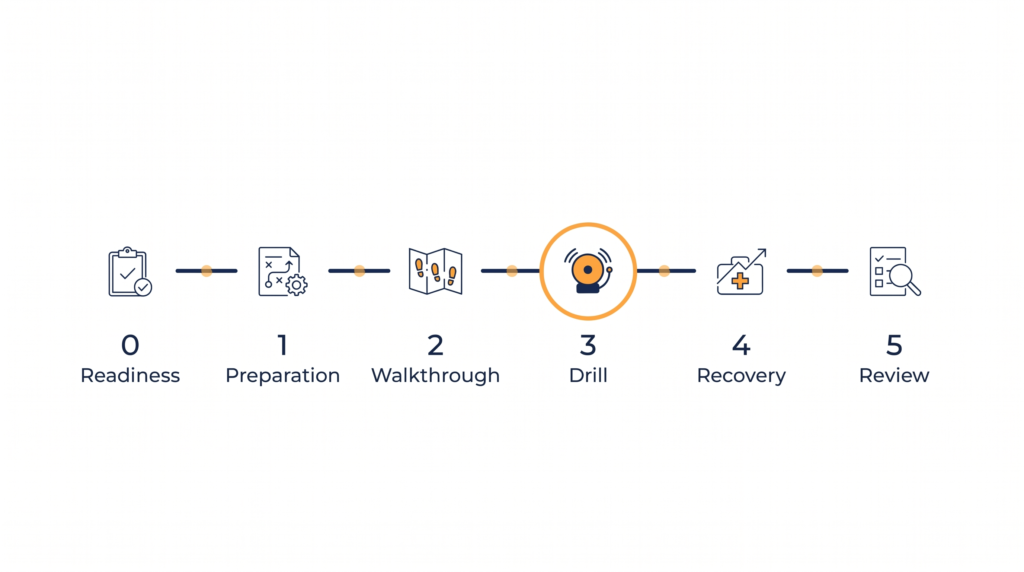
The School Safety Drill Sequence Guide has six stages:
- Stage 0: Readiness and risk assessment. Schools complete a safety audit and a localized contingency plan. They mark lockdown and evacuation areas and list emergency contacts with the PNP and LGU.
- Stage 1: Learner preparation, consent, and safeguarding. Schools give advance notice and get parental consent. They also arrange safe options for learners who need them.
- Stage 2: Classroom discussion and walkthrough. Teachers explain what the alarm means. They also explain what learners should do.
- Stage 3: The drill. The alarm sounds. Classrooms lock down, and learners stay out of sight. Then the school evacuates in an orderly way.
- Stage 4: Recovery and reunification. Staff account for every learner. They also provide psychosocial support.
- Stage 5: After-action review. Schools identify gaps. Then they update the School Contingency Plan.
Every step follows a “Do No Harm” principle. DepEd strictly prohibits anything that could cause fear. This includes aggressor role-play, imitation weapons, simulated gunfire, and simulated casualties.
Why the Alarm Must Work First
The alarm starts the drill. In Phase 1, the School Head sounds the school’s designated duress signal. Everything else depends on this moment. Teachers lock doors, turn off lights, and move learners away from windows. They do this only because they recognize the signal.
DepEd’s readiness guidance goes further. Under Stage 0, schools must set up distinct audible and visual duress alarms. These alarms must clearly separate an active threat from a routine fire or earthquake evacuation. DepEd’s drill evaluation tool also checks whether the drill stood apart from those routine alarms.
The required actions are opposite. For a fire or earthquake, people leave the building or drop, cover, and hold. For a lockdown, people stay inside, secure the room, and stay out of sight.
If learners hear a sound they link to evacuation, they may run outside. That is the wrong move during a lockdown. A distinct signal prevents this confusion from the start.
Common Gaps in School Alarm Setups
Most schools find their gaps during Stage 0 or the after-action review. The most common gaps are these:
- One bell for everything. The same bell marks class changes, fire drills, and earthquake drills. No distinct sound is left for a lockdown.
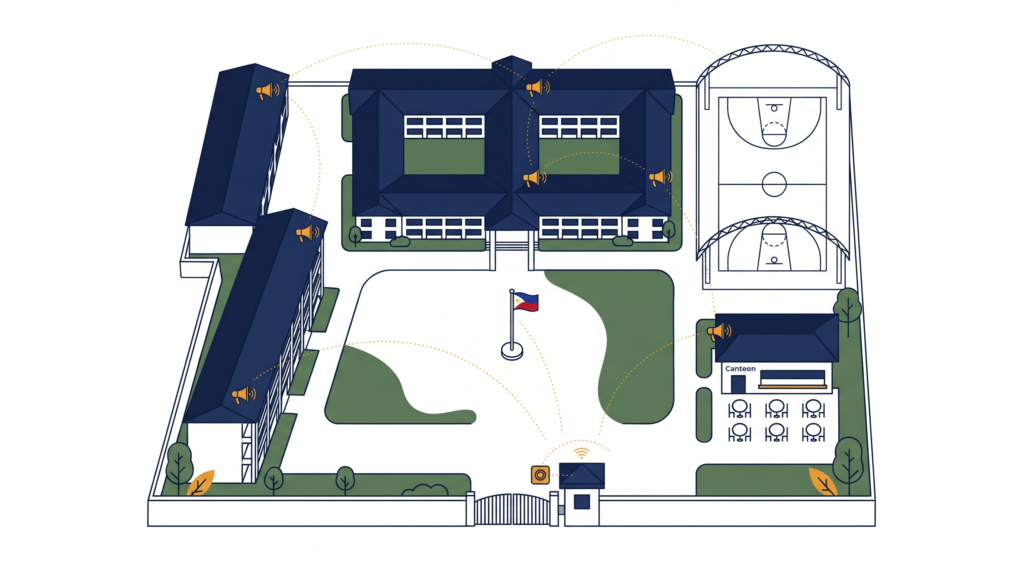
- Coverage that stops at the building. Covered courts, open grounds, canteens, gates, and annex buildings are often hard to reach with sound.
- No visual alert. Learners with hearing difficulties may miss a sound-only signal. So may people in noisy workshops and crowded gyms. This is why DepEd’s guidance includes visual alarms.
- Only one place to trigger it. If only the principal’s office can sound the alarm, the alert depends on someone reaching that office. Guards at the gate and Wing Captains may spot a problem first.
- Brownouts. A wired bell or PA system needs mains power. It may fail when it is needed most, especially during typhoon season.
Checklist for a Good Duress Alarm
Use this checklist when you review your School Contingency Plan:
- ☐ The lockdown signal sounds nothing like the class bell, fire alarm, or earthquake signal.
- ☐ A short spoken message, such as “Lockdown, lockdown,” removes any doubt. It uses the language your learners understand.
- ☐ Every classroom, the covered court, the canteen, and open grounds can hear it.
- ☐ Strobe lights give a visual signal. Lockdown, evacuation, and all clear each have their own color.
- ☐ Guards, the admin office, and Wing Captains can all trigger it.
- ☐ It runs on battery, so it works during a brownout.
- ☐ It has a clear all-clear signal, so teachers know when it is safe to open doors.
- ☐ It can be tested regularly without alarming the community.
If most of your answers are “no,” start with the alarm. Doors, barricades, and evacuation routes all depend on people recognizing the signal.
How Hazavoid’s Wireless Alert System Supports DepEd school safety drill Procedures
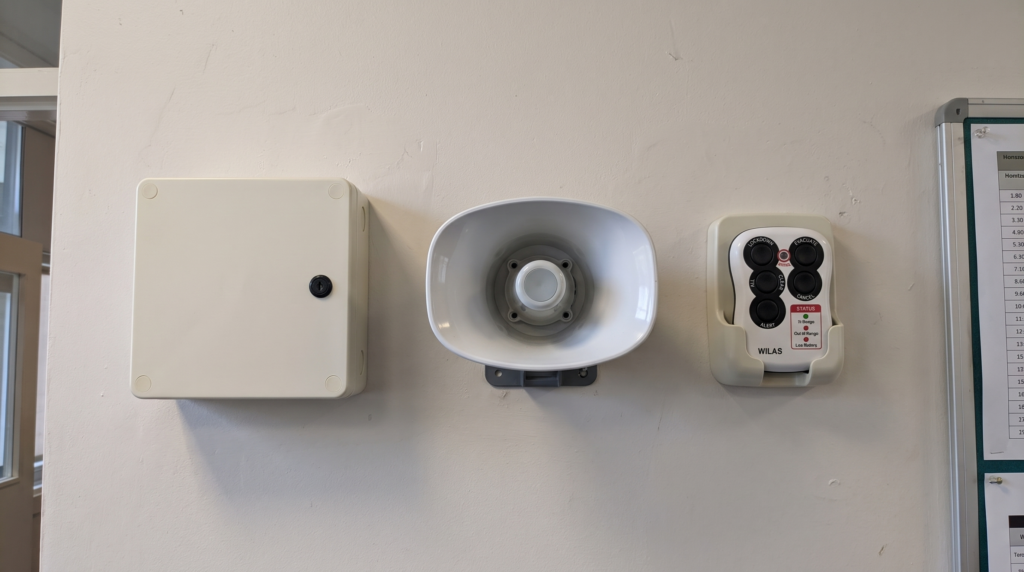
Hazavoid’s Wireless Emergency Alert System (WiLAS) suits this job. It produces distinct Lockdown, Evacuation, and All Clear alerts, and each alert has its own tone. Schools can record spoken voice-overs that match their own procedures and language.
The system pairs outdoor sirens for open grounds and courts with lower-volume indoor speakers for classrooms. Color-coded strobe beacons add the visual alert that DepEd recommends. Staff can trigger alerts from wall-mounted points or handheld wireless remotes. A guard at the gate or a Wing Captain in a distant building can raise the alarm without running to the office.
Each control module runs on battery. It charges from mains or solar power, so it keeps working during brownouts. The system has no central control panel, which removes a single point of failure. Because it is wireless, schools with several buildings or annexes do not need to run cables across the campus.
by Inventis Technology and is ACMA and FCC certified.
Next step: get your alarm ready before the next DepEd school safety drill
DepEd expects schools to update their School Contingency Plans after every drill. If your after-action review showed that learners could not tell the lockdown signal apart from other alarms, or that some areas could not hear it, now is the time to fix it.
Talk to the Hazavoid team about a duress alarm setup that fits your campus and your School Contingency Plan. Email support@hazavoid.comor call 1300 003 339.
Frequently Asked Questions
What is the DepEd National Simultaneous School Safety Drill?
It is a nationwide drill for public and private elementary and secondary schools. It was held on September 3, 2026. Schools practiced lockdown, concealment, evacuation, emergency communication, and reunification. Each school followed its own School Contingency Plan.
What alarm should schools use for a DepEd lockdown drill?
DepEd guidance asks schools to use a designated non-fire, non-earthquake duress signal. It should sound clearly different from the bells and signals used for fire and earthquake drills.
Why can’t schools use the fire alarm or school bell for a lockdown?
A fire or earthquake signal tells people to evacuate. A lockdown tells them to stay inside and hide. Using the same or a similar sound can send learners outside when they should stay in a secure room.
Does DepEd require visual alarms as well as sound?
Yes. DepEd’s readiness guidance calls for distinct audible and visual duress alarms. Visual alerts, such as strobe lights, help learners with hearing difficulties. They also help anyone in a noisy area.
What should a school do after the safety drill?
Schools must account for all learners and provide psychosocial support. They should then hold an after-action review and update the School Contingency Plan to close any gaps.
Will a wireless alarm work during a brownout?
Yes, if it is battery-powered and charged from mains or solar. A system built this way keeps working when the power goes out. Hazavoid’s system is designed this way.