

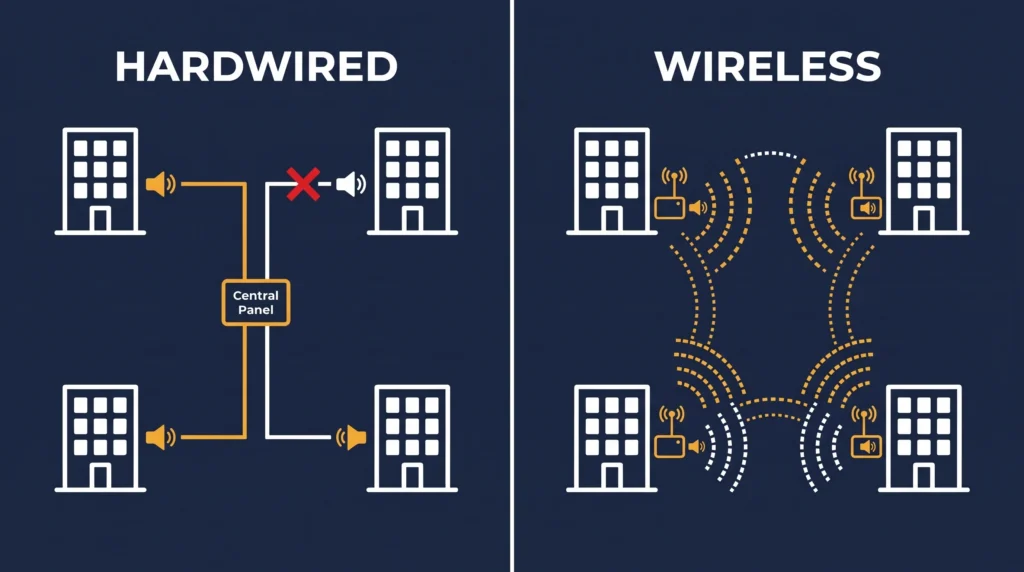
A wireless school alert system uses battery-powered units that talk to each other by radio, so no cables need to run between buildings. In contrast, a hardwired system connects every speaker and button back to one central panel. Both can deliver lockdown and evacuation alerts.
So which is right for your campus? It depends on your buildings, your budget, how fast you need it working and what happens in a power cut. This guide compares the two honestly, including where hardwired systems still make sense.
How a wireless school alert system works
A wireless system uses self-contained control units placed around the site. Each unit has its own battery, and it also drives nearby sirens or speakers.
When someone presses a handheld remote or a wall button, the signal travels by radio from unit to unit. As a result, the alert spreads across the whole site without cables between buildings.
How a hardwired alert system works
A hardwired system is usually built around a central control panel, often in the front office. Then speakers, sirens, strobes and buttons are all cabled back to that panel. Many schools also extend an existing public address (PA) or intercom system to do this.
Wireless vs hardwired: side-by-side comparison
| Factor | Hardwired | Wireless |
|---|---|---|
| Installation | Cabling through ceilings and walls, often trenching between buildings | Mount units and connect nearby speakers, with no cables between buildings |
| Disruption to teaching | Often needs holiday or staged works | Usually less, as most work is local to each unit |
| Outdoor coverage | Needs cable runs to ovals, car parks and courts | Units can sit outdoors, with solar charging if there’s no power |
| Power cuts | Depends on the panel’s backup battery | Each unit has its own battery |
| Single point of failure | A failed panel or cut cable can affect many zones | Designs with no central panel avoid this |
| Adding buildings | New cable runs back to the panel | Add another unit to the network |
| Maintenance | Fewer batteries, plus cable and panel checks | Battery and radio coverage checks |
| Voice paging and intercom | Often built in | Varies by system |
| Heritage or leased buildings | Hard where walls can’t be opened | Needs only a few fixing points |
When a wireless school alert system makes the most sense
Wireless tends to be the better fit in five situations:
- The campus is spread out. Several buildings, demountables or a distant oval all mean long cable runs.
- The buildings are old or heritage-listed. Opening walls is costly, slow or simply not allowed.
- You need it working quickly. For example, a drill review may show the bell can’t be heard in some areas.
- Power is unreliable. Storms, bushfires and typhoon brownouts are real risks in parts of Australia and the Philippines.
- The site keeps changing. Portables come and go, and new buildings arrive in stages.
When a hardwired alert system still makes sense
Wireless isn’t always the answer. Instead, a hardwired approach can be better in three cases:
- You’re building new. Cable is cheapest to run while the walls are still open.
- You need two-way intercom. Talk-back between classrooms and the office is generally easier on a wired system.
- The building needs a wired warning system by law. Larger buildings may need a compliant fire and emergency warning system under building codes. A lockdown alert system doesn’t replace that.
Combining a wireless school alert system with your fire panel
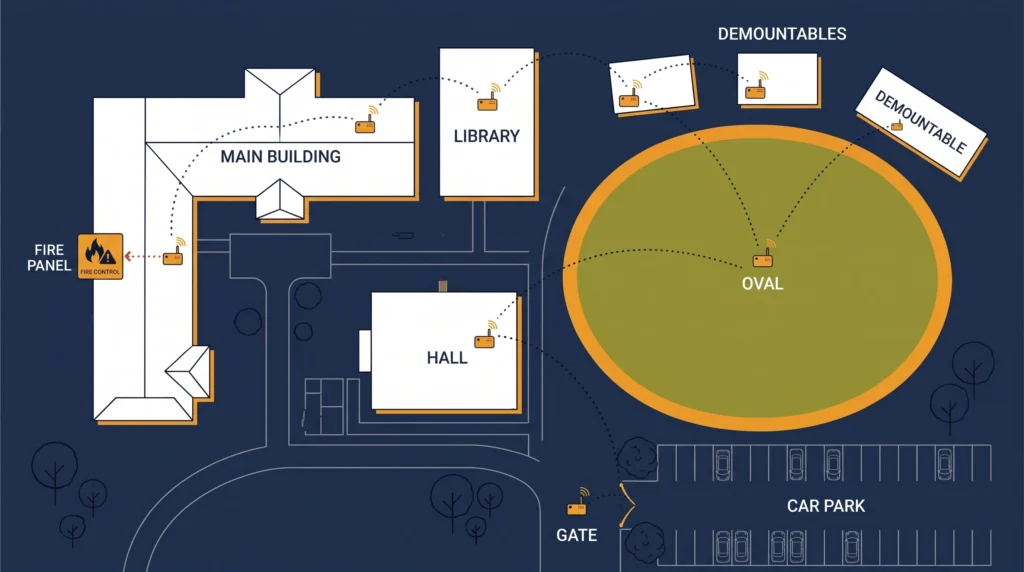
Many schools end up with both. They keep the existing fire panel and PA, then add wireless alerts where the wired system can’t reach. Outdoor areas, portables and separate buildings are especially common gaps.
Above all, the systems must work together. If a fire alarm and a lockdown alert are both active, people need to know which instruction wins. Therefore, look for a wireless system that can connect to your fire indicator panel.
What drives the cost of a school alert system
We don’t publish standard prices, because costs depend heavily on the site. However, a few factors make the biggest difference:
- Site size and layout: how many buildings there are and how far apart.
- Outdoor coverage: ovals, car parks, courts and gates need high-volume sirens.
- Indoor coverage: how many rooms need a speaker or beacon.
- Activation points: how many wall buttons and handheld remotes you need.
- Power: whether units can use mains power or need solar kits.
- Integration: whether you’re connecting to an existing fire panel or PA.
For that reason, a site assessment is the only reliable way to get a real figure.
Questions to ask any supplier
- ☐ What happens if mains power fails, and for how long does the system keep working?
- ☐ Is there a central panel, and what happens if it fails?
- ☐ How are wireless signals protected from interference and false triggers?
- ☐ Can it give separate lockdown, evacuation and all clear alerts?
- ☐ Does it have visual alerts for students with hearing loss and noisy spaces?
- ☐ Can it connect to our fire indicator panel?
- ☐ Is it certified for radio use in our country?
- ☐ How is it tested, and how easy is it to spot a fault?
How Hazavoid’s wireless school alert system is built
Hazavoid’s Wireless Emergency Alert System (WiLAS) is designed and made in Australia by Inventis Technology. Here’s how it answers those questions:
- Power: each control module has its own battery, charged from mains or a solar kit. Standby lasts about 1,000 hours without activation.
- No central panel: modules receive and relay alerts to each other, so no single box can stop every alert.
- Range: the nominal range is 300 m between control stations, and stations combine to cover large sites.
- Secure signals: wireless activation is encrypted.
- Coverage: each module drives up to 3 outdoor sirens or 18 indoor speakers. In addition, colour-coded strobe beacons are available indoors and out.
- Separate alerts: distinct Lockdown, Evacuation and All Clear tones, with voice-overs you can customise.
- Integration: it connects to existing fire indicator panels and has programmable inputs and outputs.
- Testing: LED diagnostics make faults easy to spot, and you can test from the handheld remote.
- Certification: it’s ACMA and FCC certified, with IP66 enclosures rated from −20°C to 65°C.
Next step: get a site assessment
After all, the fastest way to choose is to look at your site. The Hazavoid team can map your buildings, outdoor areas and existing systems, and then show where wireless alerts fill the gaps. If you’re still comparing signals, read our guide to lockdown alarms and the school bell first.
Book a free site assessment, email support@hazavoid.com or call 1300 003 339. For radio certification in Australia, see the ACMA website.
Frequently Asked Questions
What is a wireless emergency alert system?
A wireless emergency alert system uses battery-powered control units that communicate by radio to sound sirens, speakers and strobe lights across a site. No cables are needed between buildings.
Is a wireless alarm system reliable enough for school lockdowns?
A well-designed wireless system can be very reliable. Look for battery backup in every unit, no central panel that can fail, encrypted signals and easy fault diagnostics.
Does a wireless lockdown system work during a power outage?
Yes, if each unit has its own battery. Hazavoid’s control modules run on an internal battery charged from mains or solar, with about 1,000 hours of standby time.
Can a wireless system replace our fire alarm?
No. A lockdown and evacuation alert system supplements the fire detection and emergency warning systems your building may legally require. It can connect to your fire indicator panel so the two work together.
How far can a wireless school alarm reach?
It depends on the system. Hazavoid’s control stations have a nominal range of 300 m to the next station, and stations can be combined to cover large campuses.
How much does a school emergency alert system cost?
Cost depends on the size of the site, the number of buildings and outdoor areas, the number of speakers and activation points, power options and integration needs. A site assessment gives the most accurate figure.