

Lockdown vs lockout comes down to where the danger is. A lockdown keeps everyone inside and out of sight because the threat may be on site. A lockout locks the outer doors because the threat is outside, so classes carry on as normal.
Two other responses often get mixed up with them. An evacuation moves everyone out to a safe place, while shelter-in-place keeps people indoors to avoid a hazard such as smoke or a storm. This guide explains all four in plain English. It also compares the terms used in Australia, the US and the Philippines.
Lockdown vs lockout: the quick answer
| Lockdown | Lockout | |
|---|---|---|
| Where is the threat? | Inside or very close to the school | Outside the school grounds |
| What do doors do? | Every room is locked | Outer doors and gates are locked |
| What happens inside? | Lights off, quiet, out of sight | Lessons usually continue |
| Can people come and go? | No one opens a door until the all clear | No one enters or leaves |
What is a school lockdown?
A school lockdown is a response to a threat that may be inside or near the school. Students and staff go into the nearest lockable room, lock the door and turn off the lights. Then they stay quiet and out of sight until the all clear.
During a lockdown, nobody opens the door, even to someone who knocks. That rule protects everyone in the room.
What is a lockout?
A lockout is used when a threat is outside the grounds, for example police activity in the street. Staff lock the outside doors and gates, so nobody comes in or goes out. Inside, however, lessons usually continue.
In the US, the widely used Standard Response Protocol (SRP) now calls this action Secure rather than Lockout. The idea stays the same.
When does a lockout become a lockdown?
A lockout can turn into a lockdown if the threat comes closer. For instance, a person seen near the front gate may move into the grounds. When that happens, staff switch from locking outer doors to locking every room.
That’s why the two signals must sound different. If they’re easy to confuse, people may relax when they should hide.
What is an evacuation?
An evacuation moves people out of a building or area to a safe assembly point. Fire is the classic example, but gas leaks and some building problems also need one.
Australian schools often split this into two procedures. An on-site evacuation moves people to an assembly area within the grounds. By contrast, an off-site evacuation takes them to a place away from the school.
What is shelter-in-place?
Shelter-in-place keeps everyone inside because it’s safer than being outdoors. Common reasons include bushfire smoke, severe storms, a nearby chemical spill and very poor air quality. Depending on the hazard, staff may close windows, turn off air conditioning or move people to an inner room.
The SRP calls this Shelter. It also asks the person making the announcement to name the hazard and the safety strategy.
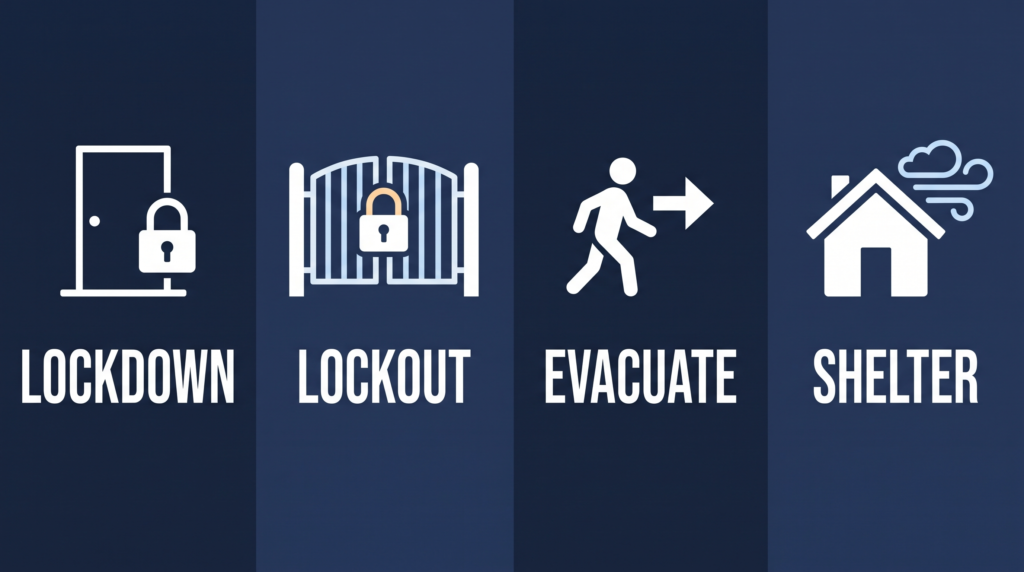
Lockdown vs lockout terms in Australia, the US and the Philippines
The actions are much the same everywhere, but the names differ. For example, Victoria’s Department of Education requires every school emergency management plan to include five core procedures. Similarly, the SRP in the US uses five actions. Meanwhile, DepEd in the Philippines builds lockout, lockdown, evacuation and reunification into each school’s contingency plan.
| What happens | Australia (Victoria) | United States (SRP) | Philippines (DepEd) |
|---|---|---|---|
| Threat inside or close: lock rooms, hide | Lock-down | Lockdown | Lockdown |
| Threat outside: lock outer doors | Lock-out | Secure | Lockout |
| Move everyone to safety | On-site or off-site evacuation | Evacuate | Evacuation |
| Stay inside to avoid a hazard | Shelter-in-place | Shelter | Part of disaster procedures |
| Keep students in rooms while halls clear | No standard term | Hold | No standard term |
| Return students to families | Recovery planning | Reunification | Reunification |
These differences matter if your school works with visiting staff, international students or overseas partners. A visiting teacher who hears “secure” should know exactly what to do.
Why schools use plain language, not codes
Some schools once used coded announcements, such as colour codes, to avoid alarming students. Today, most guidance recommends plain language instead. The SRP, for example, pairs each action with a short instruction. Its lockdown instruction is “Locks, Lights, Out of Sight.”
Plain words work because everyone understands them straight away. That includes relief teachers, visitors, contractors and emergency services. A code only works if everyone has learned it.
Why lockdown and lockout need different signals
The most dangerous mix-up is between lockdown and evacuation, because the actions are opposite. One says stay in and hide, but the other says get out. Lockdown and lockout are a closer pair, so they’re also easy to confuse.
If a school uses one bell for everything, people have to stop and decode it. In a real emergency, those seconds matter. A good alert system therefore gives each response:
- A different sound, so lockdown, lockout, evacuation and all clear never sound alike.
- A spoken message, such as “Lockdown, lockdown” or “Evacuate to the oval”.
- A visual cue, because colour-coded lights help students with hearing loss and anyone in a noisy room.
- A clear all clear, so people know when it’s safe to unlock doors.
We cover this in more depth in our post on school lockdown alarms and the school bell.
A quick lockdown vs lockout check for your school
- ☐ Do staff and students know the difference between a lockdown and a lockout?
- ☐ Does your emergency plan use the same words as your announcements and drills?
- ☐ Does each response have its own signal, separate from the bell and fire alarm?
- ☐ Is there a visual alert as well as a sound?
- ☐ Is there a distinct all clear?
- ☐ Have relief teachers and visitors been told what each signal means?
How Hazavoid signals each response
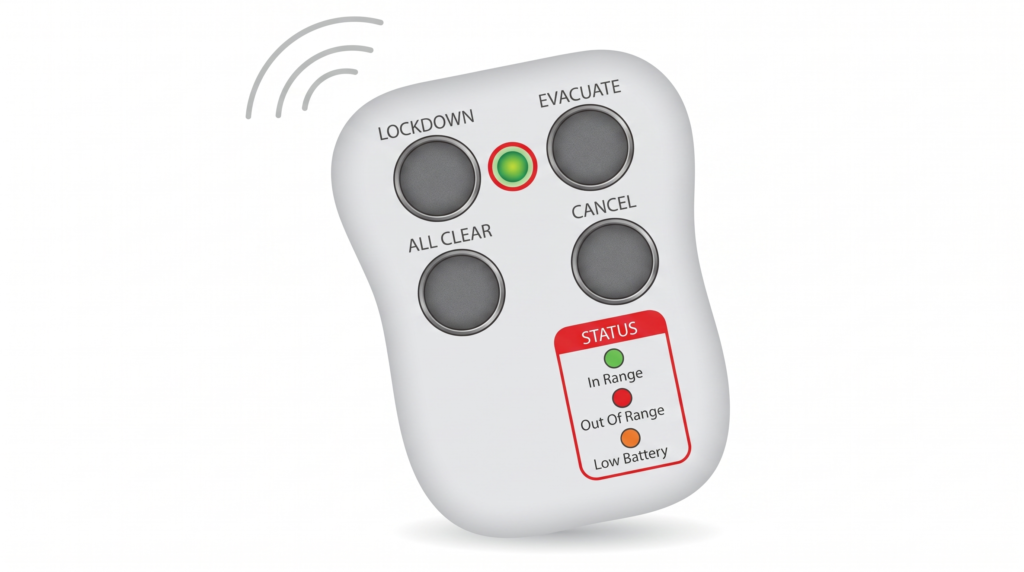
Hazavoid’s Wireless Emergency Alert System (WiLAS) gives schools separate Lockdown, Evacuation and All Clear alerts, each with its own tone. You can also customise tones and spoken voice-overs to match the words in your plan. In addition, colour-coded strobe beacons give a visual cue for each alert, indoors and outdoors.
Staff can trigger alerts from wall-mounted points or handheld remotes anywhere on site. Each unit runs on battery with mains or solar charging, so there’s no single point of failure.
Next step
If your school’s signals don’t clearly match its procedures, the Hazavoid team can help you plan alerts for each response. Book a free site assessment, email support@hazavoid.com or call 1300 003 339.
Source for Victorian procedures: Victoria Department of Education, core and specific response procedures.
The Standard Response Protocol (SRP) is a trademark of The “I Love U Guys” Foundation. Hazavoid is not affiliated with or endorsed by the Foundation
Frequently Asked Questions
What is the difference between a lockdown and a lockout?
A lockdown is for a threat that may be inside or very close to the school, so everyone locks themselves in rooms and stays out of sight. A lockout is for a threat outside, so only the outer doors and gates are locked and normal activity continues inside.
What is the difference between shelter-in-place and lockdown?
Shelter-in-place protects people from an environmental hazard, such as smoke, a storm or a chemical leak, by keeping them indoors. A lockdown protects people from a person or threat by hiding them in locked rooms.
What does “Secure” mean in a school emergency?
In the US Standard Response Protocol, Secure means getting everyone inside and locking the outside doors. It is the same idea as a lockout in Australia and the Philippines.
What are the core emergency procedures for Victorian schools?
Victoria’s Department of Education requires every school emergency management plan to include on-site evacuation, off-site evacuation, shelter-in-place, lock-down and lock-out procedures.
Why shouldn’t schools use code words for emergencies?
Code words only work if everyone has learned them. Plain language is understood straight away by relief teachers, visitors and emergency services.
Should lockdown and evacuation have different alarms?
Yes. The actions are opposite, so the signals should be impossible to confuse. Each should have its own sound, ideally with a spoken message and a visual cue.